Watch the first five minutes, decide on the next fifty-two.
Wednesday, January 30, 2013

Thursday, January 24, 2013
Perplexatory
My hands! My hands!
What are they saying now?
What are they saying now?
Thank God.
Thank God.
Saturday, January 19, 2013
Haha.
The Madman Laughs at Everything: Spring 2013
"The Moon says you're home" - Madness 3:7
freak on-
Tuesday, January 8, 2013
Love (1)
I
I do not know about love. I only know it draws from me miraculous things, nearly always shocking. A relationship, and the love in it, is steady with some underneath affection coursing through the lovers veins--but that moment of love, is felt in surprising moments. Not the fabricated ones, the ones that are only beheld by both parties, and very often beheld privately.
II
I do not know about love. I only know it scatters out my fingers and empties itself like a gasping breath after near death. The experience of love is encompassing in majesty and equal in its propensity for devastation, but it happens in moments; little surprises we can only behold. We surprise ourselves with our ability to be kind, to be cruel, and to our attachments. We see someone in ourselves we thought about, but couldn't imagine; love, flashes it's glisten in these moments.
III
I do not know about love. I only know it secures me in place; it gives me something to grind against, and shave off the prickly points of my personality. It takes a coal that fancies himself a diamond, and shows him how much he shines by first showing him how black he is. A thorough scrubbing love is.
IV
I do not know about love. I only know it when it stings in pleasure or punctures in pain, and reminds me that love has never been either, and is often considered both.
V
I do not know about love. I only know it is a conversational mouth; a heaving chest; a sometimes confusion, and a quiet discipline that must go with it. Love is often clarity, but that is clarity, not love. Love won't stand for any definition; it is too passionate, too subtle, too oxymoronic to grab ahold of and cast a spell with.
VI
I do not know about love, but I know that we can, because we can't help ourselves.

Saturday, December 8, 2012
The People's House
I
It is true that we can fall upon our own swords. The ascent of the self is the highest cliff we can climb and crumble upon. It is a very real possibility that we will appear to our future selves as derelicts do to us today. I grew up with a sensation of loss, very, incredibly real to me. It was not a lost toy, but a lost life, repeatedly. In these fires, great things are fuzed, and some joints that need to always be pliable became fixated by the same heat. It may be this way for some part of you, people.
II
The consequences of these precise and obtuse mechanisms of the psyche working together make for an interesting engine. The way that resources get used seem manifold, but it is analogous to the variations in the color of garbage, or salads. It is how there are many different products, but they are all different shades and colors of convenience. This dynamic exists on an individual level, and reflects in our international community. We see in the wars and disturbances man cannot help but create--we've basically allowed a defining trait of our species to be subjugation and war amongst itself--we see in this eternal struggle, the reflection of common individual struggle.
III
Man preceded civilization, and yet both function with different dynamics that overlapping, neither necessitate, and often invalidate, one another. The individual struggle that reflects in this civilization, and in many before us, of "wanting-ness"leaves man always begging for more. A society of beggars clothed in the convenience of life reflects the feelings of individuals that base satisfaction on the exercise of will in a personal vacuum. This is a way of being, not of thinking--it speaks to it's opposite. It reflects the communal desire for joy; running up against different definitions that come into focus once one is back beneath the clouds.
IV
Yet neither necessitate the other, and both may invalidate the other. Man can be soaked deep in his own heart, "free from greed and wanton needs" as Lao-Tzu says in the Tao Te Ching concurrently with a society that is critical of such a man--naming his unconventional ways as the root cause of the societies issues. Conversely, many unlearned people blame society alone for the snakes writhing within themselves, and society in turn points back with blame or shame. It is never this clear cut, it is always both. This is the Yin and Yang I suppose.
V
Thus, pointing in the direction of the other, we are in part pointing to a part of ourselves. By that perspective then, we begin upgrading our processors made in the fiery experience of spongy youth. We ping off the other, that which we point to shamingly, and increase our own bandwidth. This is all theory, though I have seen a great amount of difference in the stages of being and I am still very young, so I don't even fully comprehend the meaning of 'change,' or 'difference.' Like the Grand Old Master said, "He who feels punctured, must once have been a bubble."
VI
The answer to the ascent of the self; the way up the rocky crag is brought about then by neither pointing away, or pointing at one self solely as both are reflections off of one another. It is instead, what the conversation hangs within. Life hangs in the balance, and what it hangs in is where the minds must rise and float to be able to ascend the valley. It is how, as said by The Madness, the ground appears as the top of a mountain. To play it out practically, this means a mystical approach to the conversation about practical and pressing matters like slavery and the privatization of natural resources in an increasingly demanding world.
VII
Language creates reality, and reality influences the creation of language; after all, the sounds of primitive man were responding to something--whether it be a call for the moon to send rain, or the desire to convey the first experience of what fire was when lit by the angry lightning. These old tales and myths that flow into the fabric of cultures create the intellectual soup our minds rise up within, and become entrenched with. On a macro scale, these change, and if we think consciously about the macro scale, pointing to it, we see it pointing back to us on a micro scale--so perhaps we begin our species ascent with communal individuality. We must blend the two, not just prickle against what in the other, is deficient in ourselves, certainly not dismissing the concept of unity because the language creates an oxymoron.
VIII
These answers are long, and never complete. If they would be, they would not be the correct answers. We are carrying these forward and dipping them into every generation. For their struggles were, and will be like ours, they will just have different names, and different problems--but the struggle is defining to life; as such, as long as our species can experience joy, it must find the pain, and when it knows that both are neither tied to them alone, or to society away from themselves, then we can begin the delicate and necessary process of caring for all variation of our species.
IX
We are sold on the delusions created by language--that blessing and curse of our species. We can communicate finite concepts, yet the way in which we express them, the context of the epoch the communication is conveyed in, and the subjective understanding on the receiving end, all make for an enterprise doomed to fail if left to itself. It is trying to talk a person who is grieving out of grief, or just allowing them the silence or histrionics to grieve and experience that with them to lessen the load. Introducing what is commonly understood as the mystical approach would allow the scrutiny purported by the inquiry, of 'what is better?' Better cannot be narrow enough to be only what is best for the individual--come commonly to mean 'the most'--and cannot also be only what is best for society, else you end up with an impossible ideal.
X
The answer is undulating, it does not hold on to itself, it doesn't hold on to anything but basic understandings that all should eat, sleep, and drink water. That we must reduce suffering caused by the definition of life, and that we should look never to impose suffering on others in our species; understanding that we are really just pointing at ourselves. To introduce a previously 'mystical' word into the mix, would be to allow all able, to experience affection. If we can even start with such a basal experience of joy, then perhaps one day, far away, we can attain the ability to love--one another, and ourselves in a manner which enables and promotes the same in others. In closing, if the modern intellectual revolts at the thought of love as a tired and overused and misunderstood answer, then perhaps we should begin our inquiry and common goal with a concerted effort for the experience of affection. It will change the world, already has, and will again.
Thursday, November 29, 2012

Wednesday, November 21, 2012
Thanksgiving.
My brain is moving right now. It feels fantastic. Creativity really is the key to moving deeper into the treasure room of inspiration. "The Madman Laughs at Everything," my seven year attempt at a book is coming to a head. It's been accepted as my final project so I can kill two birds with one stone.
I want to write to you about how everything is an opportunity. It sounds boring, I hope it is not. This is fundamentally, a primary aspect of personhood that the majority of our species is endowed with--the ability for self-correction.
This includes necessarily, our ability to perceive our surroundings. So this primarily defining opportunity for man lies in his perception--that is to say, the way the raw data of human lives is processed. It's using 'Emotional Sonar' to use a term from, "The Madman Laughs at Everything" -
Emotional sonar exposes, with muddy strokes, where we stand in relationship with our plod towards the grave. We can use questions about how we feel cyclically with similar relationships. Like how much do I think of food now versus when I was sixteen? What do I think about it--am I still not really thinking about it much? Way more than I think of other things? etc. etc. Questions along this vein can ensure a tilled psyche. This is not necessary for joy--just another tool to be used when the experience of life's confusions are too confounding to just let be, play with, or laugh about.
The trait that sets us apart from smart chimps is the ability to ask 'why'--it's our blessing and concordantly, our curse. These kinds of questions are in the employ of one concerned with adhering to the common religious understanding of, "Love your God above all things, and love one another like you love yourselves." All the different iterations of what 'God' or 'Love' implies is particular to the religious context it's coming from--even if it's the church of the secular, which claims to be nowhere, and is simultaneously everywhere.
It can be difficult pluming the depths and heights of one's constantly changing dynamic. A conception of God, or Love, or anything that seems larger than life, is a triangulation that affects everything. As our understandings about our relationship with these concepts opens up, so too the concepts themselves continues opening up, and in return, our ability to love ourselves, and finally our ability to love others.
'Love' is like 'God' to us because both take a bit of belief and both come with a myriad of applications, understandings, and cynicism; often getting in the way of one another, right when they propose to be one and the same.
Opportunity abounds when one knows how free they are; and freedom is never anarchy, it's always secured in order. Part of that freedom is the sonar of life helping guide us through the deep crags in every part of life's ocean; from the glittering surface, to the unfolding deep.
Happy Thanksgiving. I hope you feel thankful all the time.
Karn
I want to write to you about how everything is an opportunity. It sounds boring, I hope it is not. This is fundamentally, a primary aspect of personhood that the majority of our species is endowed with--the ability for self-correction.
This includes necessarily, our ability to perceive our surroundings. So this primarily defining opportunity for man lies in his perception--that is to say, the way the raw data of human lives is processed. It's using 'Emotional Sonar' to use a term from, "The Madman Laughs at Everything" -
Emotional Sonar: Triangulation against anything processed by the primary agent.
The trait that sets us apart from smart chimps is the ability to ask 'why'--it's our blessing and concordantly, our curse. These kinds of questions are in the employ of one concerned with adhering to the common religious understanding of, "Love your God above all things, and love one another like you love yourselves." All the different iterations of what 'God' or 'Love' implies is particular to the religious context it's coming from--even if it's the church of the secular, which claims to be nowhere, and is simultaneously everywhere.
It can be difficult pluming the depths and heights of one's constantly changing dynamic. A conception of God, or Love, or anything that seems larger than life, is a triangulation that affects everything. As our understandings about our relationship with these concepts opens up, so too the concepts themselves continues opening up, and in return, our ability to love ourselves, and finally our ability to love others.
'Love' is like 'God' to us because both take a bit of belief and both come with a myriad of applications, understandings, and cynicism; often getting in the way of one another, right when they propose to be one and the same.
Opportunity abounds when one knows how free they are; and freedom is never anarchy, it's always secured in order. Part of that freedom is the sonar of life helping guide us through the deep crags in every part of life's ocean; from the glittering surface, to the unfolding deep.
Happy Thanksgiving. I hope you feel thankful all the time.
Karn
Friday, November 9, 2012
Sunday, October 28, 2012
Hot and Cold
 I think often of living overseas. I am very concerned about the oil crisis lately. Europe, England, and some previous lands the British colonized have infrastructure that was created before the oil boom. America on the other hand, is a country that won it's power, and was raised to heights because of oil. The difference in highways, cities, and rural areas compared with the majority of the rest of the world is a clear indicator. Though those countries have now much macadam, the underlying architecture in many areas still lends itself more to small communities. You see this still in city areas, but suburbia is a goner. I think we'll still have some electric before I die, however everything we can think of when we think forward--or perhaps just this idiot writing--runs on oil. Some part of it's history, somewhere on the road to potentially available, involves oil, and usually some kind of human slavery. Forty million slaves, roughly, now days--unseen and sequestered from the real world. Did you know that motions that have anything like the word, 'inequality' in their title don't usually get sponsored financially? Christyia Freeland recently wrote a book about it. Take this and scale it beyond reasonable, and you have some idea of the difficulty we face as a species.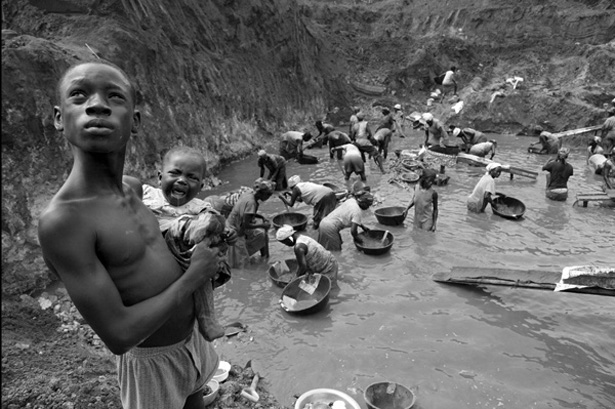
The picture of these slaves represent the gold used in making products like the computer I type this on, and the smartphone I'll read this later on. It's the only way these electronic devices work so quickly and cheaply. Gold is a magnificent conductor, so we better get it cheap; but it's hard to claw from the ground after the burst in population (mimics oil use) and the idea that everyone should have it all. So the answer? Subject your own species through fear, and keep it obscure enough that the majority doesn't have a revolt in their consciousness, and we're pretty trapped deep. I mean writing about how it sucks, is being done on a device made through and through with oil (plastics, transportation, etc. etc.) and simultaneously supports slavery. That's my computer...you know, those devices that are more than a passing fad?
Back to the narrative: after Rome, France, Germany, England, then, America grows--and she discovers the use of oil. When this spreads to the other worlds, all reeling from not being the ruling super power anymore (Greece anyone?) then we see oil based empires rise across the world. The old war of Greeks and Persians is today played out for oil, and still uses the reasons we as a species created in the Middle Ages. The turn to Humanism was born from intellectual cross-pollination during the fifteenth century, so all the rampant 'individuality' and 'choice' that people love in their redefined, temporary epochs, would be totally lost without the Muslims that came up through North Africa into Spain. Where do you think St. Augustine and St. Aquinas got their understandings of the Greeks?

As they had workers and slaves, we too have those, just on an international scale thanks to cheap energy. By the way, if you don't think energy is cheap, a gallon is about eleven dollars in India, and three to four dollars in America - then imagine a gallon of Starbucks coffee - it would be like fifteen dollars with current prices of a grande at $1.95 with a personal cup discount. Three to four dollars explains our defense budget almost single handedly when compared with world oil prices--think of it as really cheap liquid...even bottled water at roughly two dollars for sixteen ounces would equal about sixteen dollars a gallon!
The places that have oil available cheaper? We war with them and simultaneously sell them our older weapons; cause you know, oil makes everything you and I take for granted. That hot shower in a tub? More people than not don't have that luxury. Heat? Ever heard of a blanket and suffering through the cold? Even our cancer, horrible, saddening, miserable, disheartening, soul-sucking, and who gives great joy in beating away, is a problem that comes after we've sufficiently secured clean drinking water. It is why THE FRESHWATER is the name of everything I do; it's basic, and a lot of people don't have it. We look upon history and our own parents and wonder why they didn't contribute to the same end--the security of the species--and as we have this thought, we remember to "be the change we wish to see in the world" and suddenly my love of all things Apple makes me complicit in murder. A diamond? Ha! There is one place I've heard of in Canada where the miners aren't basically slaves. In fact, in ninety plus percent of the cases our diamonds come from actual slaves--families held hostage, wives and daughters raped in front of their husbands and fathers eyes who have their eyes held open at gunpoint and threat of death to their other smaller children, limbs cut off, tortured or 'disappeared.' They probably don't think about a heater going out, or a constant lack of money--the idea of even owning to them is lost; they think only of being able to be another day, and some think of escaping (though often found the torture is inflicted even worse upon their homes and extend through generations that are not able to be generative anymore).
You know how we are arguing about social security for the elderly and presuming that our generation will have to deal with the economics of its failure? Well, when it was written, taxes were in the seventy percent for the wealthiest. We scaled personal wealth, but kept the legislated sharing up to the kind hearts of money hoarders; then we convinced everyone--everyone and anyone that we could, in any way that we could--that they should also do that. We became the oil for the markets engine, and the engines of our lives, run entirely on the depleting substance.
So I was born in the heat, and mostly raised in the cold. If I don't make a decision in twenty years, I may be paddling across the Pacific when I'm seventy. The Atlantic would probably be better. The sense of adventure and danger would have to re-enter man.
The Age of Boldness would necessarily be ushered in.
So I think of moving back to the heat, or near the equator. I like the inland not because I don't love the ocean, but I believe the coast is the first to sink. The culture will have to spread inwards. Swarms of culture is an easy way to visualize it.
Thursday, October 18, 2012
Another Record for Life Lived

I'm thrilled to introduce you to the second of a three album arc -
On October 30th, 2012, at 9:30, I'll be playing at Canal Street Tavern to commemorate my 'Roaring Twenties' and look ahead to the fourth decade of my time here (to commence mere hours later on October 31st). ROSEBUSH & THE PURSUIT OF DREAMS will be available, with digital release scheduled for Q1 2013. If you can make it, I hope to see you there, I'll be playing for a potent 30 minutes. I'd be honored to entertain you, sharing some new and old songs with you.
For those interested further, here's a quick story about this album:
We only had the honor of playing this circus out five or six different days throughout the year--but those days were deeply lived, and all the juice from the always over-ripe fruit of life was relieved through our thorough mastication of time. This album is a record of those days, and the songs on it point to days before, during, and after its studio capture; it's about a three year effort, and we think you'll really enjoy it. Hope to see you at Canal Street Tavern in Dayton, Ohio, on October 30th at 9:30.

Subscribe to:
Posts (Atom)
